
 0800 464 7677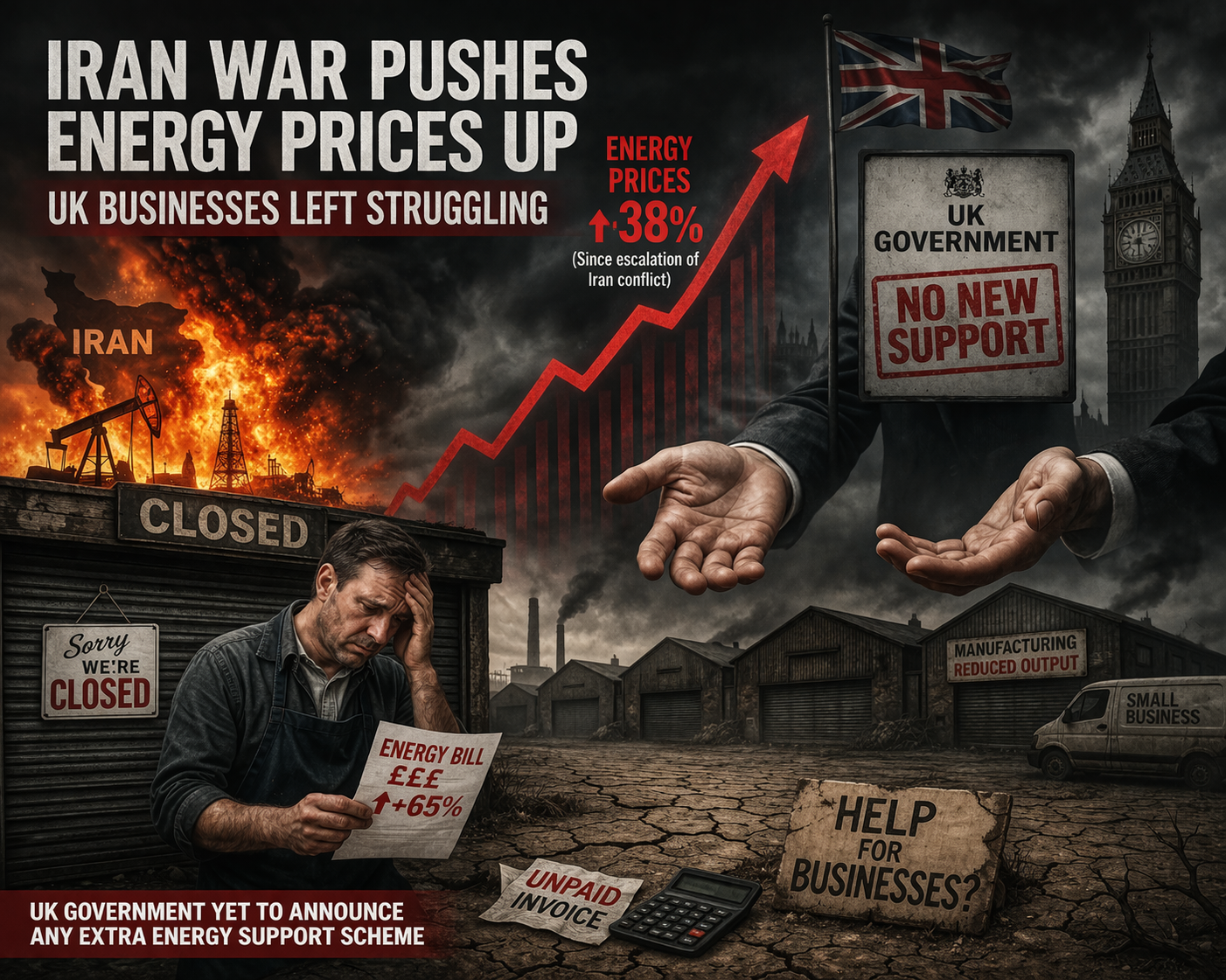
 Ian Wright
 The short answer is that Chancellor Rachel Reeves has yet to announce any support for small businesses hit by rising energy costs due to the ongoing US/Israeli War against Iran.
But you can get a free quote here.

This is in sharp contrast to the initial phases of Russia’s invasion of Ukraine in 2022 when the UK government responded with the Energy Bill Relief Scheme, which closed, on 1 April 2023.
It was succeeded by the Energy Bills Discount Scheme which ran from 1 April 2023 and 31 March 2024.
Therefore at the current time, your best bet to reduce your energy costs is to get a free business energy quote by clicking here.
You can also see the latest business electricity rates and gas prices here.
According to the BBC: “Energy bills for millions of consumers in England, Scotland, and Wales are about to fall for three months from April under Ofgem’s price cap, which is updated quarterly, but there is likely to be a big jump in gas and electricity costs over the summer.”
But this is for consumers only and does not apply to business energy customers.
What type of support might be offered?
It’s impossible to say with any certainty but here’s what was offered under the two previous schemes mentioned above:
Energy Bill Relief Scheme
Eligibility
The scheme will be available to everyone on a non-domestic contract including:
- businesses
- voluntary sector organisations, such as charities
- public sector organisations such as schools, hospitals and care homes
who are:
-
on existing fixed price contracts that were agreed on or after 1 December 2021
-
signing new fixed price contracts
-
on deemed / out of contract or standard variable tariffs
-
on flexible purchase or similar contracts
-
on variable ‘Day Ahead Index’ (DAI) tariffs (Northern Ireland scheme only)
…
The amount your bills will be reduced
The government will provide a discount on your gas and electricity unit prices. To calculate your discount, the estimated wholesale portion of the unit price you would be paying this winter will be compared to a baseline ‘government supported price’ which is lower than currently expected wholesale prices this winter.
For all non-domestic energy users in Great Britain and Northern Ireland this government supported price has been set at:
- electricity – £211 per megawatt hour (MWh) / 21.1p per kilowatt hour (KWh)
- gas – £75 per MWh / 7.5p per KWh
For comparison, when the scheme was announced, wholesale costs in England, Scotland and Wales for this winter were expected to be around:
- electricity – £600 per MWh / 60p per KWh
- gas – £180 per MWh / 18p per KWh
To ensure a level of support comparable to the domestic scheme and consistency between the domestic and non-domestic schemes, the government supported price is based on the implied wholesale element of the Energy Price Guarantee.
However, the final per unit price paid by non-domestic customers will differ as it will also reflect other costs such as network charges and operating costs, plus the impact of competition between suppliers.
The Energy Bill Relief Scheme is not subject to a price cap review, unlike the Ofgem price cap for the domestic market and the approach taken by the Energy Price Guarantee.
Energy Bills Discount Scheme
Eligibility for the EBDS baseline discount
The scheme is available to everyone on a non-domestic energy supply contract with a licensed energy supplier including:
- businesses
- voluntary sector organisations, such as charities
- public sector organisations such as schools, hospitals and care homes
who are:
-
on existing fixed price contracts that were agreed on or after 1 December 2021
-
signing new fixed price contracts
-
on deemed/out of contract or variable tariffs, or
-
on flexible purchase (or similar) contracts
-
on variable ‘Day Ahead Index’ (DAI) tariffs (Northern Ireland scheme only)
…
The support you may be eligible to receive
Most non-domestic customers will not see additional support on their energy bills from April and any support is likely to be significantly reduced. It is important that organisations continue to shop around for the best deals as the actual price you pay for your energy will vary between energy suppliers.
How the baseline discount is applied
Eligible non-domestic customers will receive a per-unit discount to their energy bills during the 12-month period from April 2023 to March 2024.This is subject to a maximum discount.
The relative discount will be applied if wholesale prices are above a certain price threshold.
For most non-domestic energy users in Great Britain and Northern Ireland these threshold prices and maximum discounts have been set at:
- electricity – £19.61 per megawatt hour (MWh) with a price threshold of £302 per MWh.
- gas – £6.97 per megawatt hour (MWh) a price threshold of £107 per MWh
The discount is calculated as the difference between the wholesale price associated with an energy contract and the price threshold.
The discount is phased in when the contract’s wholesale price exceeds the floor price, until the total discount per MWh reaches the maximum discount for that fuel.
The discount is only applied to the wholesale element of the bill and therefore the final per unit price paid by non-domestic customers will differ as it includes other costs such as network charges and operating costs, which is why it is important you continue to shop around to find the best deal.
But until she announces anything, businesses are on their own.
